Career Realism Mod for FC 27
Career Mode by the Laws of Real Football
FC 27’s new economy — TransferRoom wages, Dynamic OVR, dynamic potential, youth generation — is brilliant in places and quietly breaks long careers in others. We rebuilt all 700+ Realism Mod values from scratch on top of FC 27’s systems.
- Stat
- 700+ career values
- Release:
- September 30, 2026
- Size:
- 200 KB
- Access

Wages Built on Real TransferRoom Contracts
EA added real weekly TransferRoom wages to FC 27 for roughly 440 top players: Mbappé, Haaland, Salah, Mané and van Dijk earn exactly what they do in real life. The other 20,000+ footballers still draw a wage from an internal formula that nobody ever calibrated against real figures.
In the original game the result is absurd: Summerville, Ríos and Wijnaldum in the Saudi Pro League earn 36–41K a week next to Mané on 961K. A couple of seasons later, the best players in Saudi Arabia earn 4–23K, and academy graduates rated 85+ earn 3–19K.
We fixed the formula at its foundation. Using the 440 real wages as the benchmark, we recalculated the level of every league: in the Premier League, La Liga, Bundesliga, Serie A and Ligue 1, generated wages now match the TransferRoom level.
- Generated wages match the benchmark calculation to within ~10% — the formula is calibrated on 440 real TransferRoom contracts and verified in game
- Saudi Pro League ×2.6 — Summerville, Ríos and Wijnaldum get 80–100K instead of 36–41K
- Stars earn more: 85 OVR ~×1.3, 90 OVR ~×1.9, 94+ up to ×2 the original
- League tiers recalculated: Serie A, La Liga, Bundesliga, Portugal and Turkey go up; the Premier League and Ligue 1 come down to their real level
- Young players sign cheap first contracts (−40% at 17, −25% at 18, −15% until 21), with peak earnings at 28–34
- Goalkeepers sit closer to outfield players, and strikers a little above everyone else
- Top clubs pay more than the rest of their league, but the original’s ×3.5 multiplier for the two Spanish giants is gone
- Minimum wages on transfers are doubled
The End of the 13K Superstar
In FC 27, every renewal is calculated from the current wage. A regen who signed a first contract for 8K and grew into a 95-rated star keeps asking for a percentage of 8K. That is why the best academy graduates end their careers on pocket money.
We rewrote the demands of improving players. A talent who gained +20 OVR over one contract asks for up to 9 times his old wage. In a full-career simulation, a regen who grew from 60 to 96 OVR at a top club reaches ~360K a week — in the original he would have finished on 35K.
- Improving players demand real raises at renewal — a talent who gained +20 OVR asks for up to 9 times his old wage
- Regens and academy graduates rated 90+ no longer sit on 3–13K
- Established players who have stopped improving are unaffected — no wage inflation across the squad as a whole
- Less inflation across all leagues: AI clubs offer +25% on the current wage when signing a player (was +40%)
Fair Wages in 22 Leagues Outside the Top 5
EA’s formula works well in the top leagues, but outside them it underpays by a factor of one and a half to three: a first-team regular at a mid-table Kazakhstan Premier League club earned €600–1,200 a week, and in Ukraine, Serbia and Bulgaria footballers played almost for free. We recalculated the level of 22 leagues according to their real standing in football.
- KPL — 3× higher: a mid-table regular rated 64–67 earns 1.8–3.7K a week, and the leaders pay noticeably more
- UAE — 3× higher: it is now a big-money league, just like Saudi Arabia
- Ukraine, Cyprus, Bulgaria, Serbia, Croatia, Romania, Czechia and Greece — 1.2–2.9× higher
- MLS, Japan, China, Korea and Scotland — 25–70% higher
- Catch-all leagues for the rest of Europe, Asia, Africa and the Americas — 1.5–2.4× higher
- Ireland, Turkey’s second division and England’s fifth tier are lifted to their real level
The End of the 90-Rated 18-Year-Olds
Simulate a few seasons in the original game and by the third, the world is full of 18-year-olds rated 90+ in every squad. That is broken, and it has three causes. The benchmark: the starting database has 43 players with 90+ potential (0.2%), and among 16–18-year-olds there is just one — Lamine Yamal.
Dynamic OVR. The displayed rating in FC 27 floats with form: players under 25 in “very good” form gained up to +10 OVR. An 80-rated prospect on a hot streak looked like a 90, and AI clubs bought him at that number. We capped the bonus at +4 for youngsters and +2 for veterans.
Dynamic potential. A youngster with a big gap between rating and potential gained up to +10 potential a season, ×1.3 in a top league — from 78 to 94 in two years. We halved the gains (usually +2…+5, +8 only for a record season) and cut the top-league bonus to ×1.1.
Player generation. When topping up the youth intake, the game gave each newcomer the potential of a random club-mate plus 8 — at a top club, that is 93–99. 8% of generated players would have had 90+ potential — forty times the real share. Now newcomers get a club-mate’s potential minus 3: regens are no stronger than the players they replace.
- Form bonus on the displayed rating: a maximum of +4 for youngsters and +2 for veterans (original: +10 / +5)
- AI players need real numbers to count as in “very good form” — the same thresholds as your own players
- Dynamic potential gains are halved; players with 86+ potential grow by at most +1–2 a season
- New players are no longer born with “club-mate +8” potential
- Platinum regens (with boosted attributes) are 2.5–3× rarer: 10% at 90+ potential (was 25%), 5% at 80–89 (was 15%)
- The age pyramid of new players now matches the real database: far fewer 15–17-year-olds, with the missing ones arriving at 19–21
- The average ceiling of generated players is lowered (62 instead of 69)
Scouting as a Long-Term Investment
In the original game, scouting was too easy and even a little cheaty: for small money you quickly found future superstars, sometimes on the very first attempt.
Now, when you hire a scout, you are building a whole network under his leadership — a team that travels the world for talent. It is a serious investment: a 5★ scout costs about 25M, a 4★ about 10M. Elite youth development is the preserve of the strongest clubs, just like in real life.
Scouting missions cost real money, take real time and no longer guarantee success. Youth scouting used to be easy profit with no risk. Now it is a long project that can bring a big success or fall short of expectations — just like in real football.
- Small and mid-sized clubs can afford scouts: 1★ about 500K, 2★ about 1.25M, 3★ about 2M
- The scout pool refreshes every 30 days instead of 7; up to 5 scouts from your own country
- 5★ scouts are available only to 5★ clubs
- Firing a scout costs roughly 10× more
- Missions last 3, 6 or 9 months and cost 400K / 1.2M / 2.4M
- A scout brings back no more than 3 players per report (was up to 20)
- Academy age range widened from 14–17 to 13–20; academy size increased to 30 players
- Promotion to the first team from age 15; the minimum academy contract is 1 year
- Platinum talents are exceptionally rare (0–1%), gold 2–5%, silver 8–30%, and most are bronze
- But the reward is real: young superstars arrive with the best attributes, and the ceiling for a platinum talent is raised to 97
Growth Without +10 OVR Leaps in a Season
FC 27 introduced growth profiles: every player has his own career curve — early bloomer, late bloomer, long or short peak. We kept that system fully intact and tuned only what sits on top of it.
- Training XP is reduced by roughly 30%; the bonus for an “excellent” rating and the extra for hard drills are smaller
- Development up to age 24 is slower and more realistic — no more +10 OVR in a single season
- From age 27, growth follows EA’s FC 27 curves, so late bloomers still blossom
- Players keep 100% of their XP gain until 35; decline begins at 36 and is gradual
A Living Transfer Market
In real football, a transfer is not just numbers: loyalty, time at the club, contract situation and country decide whether a move happens. Now all of that plays a far bigger role. Clubs make counteroffers instead of walking away, negotiations take longer, and players are less likely to accept just any offer.
Most importantly, the AI market has come alive. In the original game, a star who grew up at a mid-table club stayed there for years, and strong free agents sat without a club for weeks. Now the giants hunt for stars and pay real money, and a good free agent quickly finds work. All three “negotiation strictness” presets are supported.
- The AI is reluctant to accept lowball offers and rejects anything below 60% of the asking price; an offer at the asking price is accepted 80–90% of the time
- Up to 3 counteroffers per negotiation; asking prices stay within ±5–25% of market value — the AI no longer overpays or dumps players
- Clubs reply in 3–8 days, in 1–2 days during the last week of the window, and within an hour on deadline day; deadline day lasts a full 24 hours
- Selling clubs more often demand a sell-on percentage (55% instead of 35%); player swaps are rare
- Players who have spent 3–5 years at a club are much harder to lure away; fresh signings do not leave in their first year
- Players prefer to stay in their own country and region — a deliberate choice for RPL realism, easily switched off
- A club is willing to spend 70–90% of its budget on a single player — rich clubs have the money for a star
- Top clubs buy rising talents up to age 23 and return to broken-off negotiations more often
- Release clauses on talented young players are far more common: Spain 95%, Segunda 90%, Portugal 80%, MLS 50%, Turkey 25%, RPL 15%
- The renewal letter arrives 180 days out (was 90); clubs renew at least 90% of expiring contracts
- AI clubs actively sign free agents — 75% of the best land on their radar (was 5%); outside the window, every day
- Value: players aged 17–24 are 20–45% pricier, while veterans 31+ are noticeably cheaper (age 33 −45%, age 35 −72%)
A Simulation Where the Class Gap Decides
In the original game, the simulation is suspiciously uniform: the favourite gets no more than nine chances a match, while the weaker side gets its two to five no matter who the opponent is. Matches end 1–0, 2–1 or 1–1 time after time, thrashings never happen, and underdogs beat giants implausibly often.
Now the outcome is decided by the gap in class. Evenly matched teams play openly, and any scoreline is possible — from 0–0 to 4–3. The bigger the gap, the more chances the favourite gets: a Bundesliga giant in a cup tie against a Regionalliga side can win 8–0, and occasionally even 10–0. Upsets remain, but now they are real.
- The number of chances depends on the class gap: an even match gives 2–7 and 1–6 chances, while a huge gap gives the favourite 7–15 and the underdog 1–2
- Even matches average about 2.8 goals a game, like the top leagues; the odd 6–0, 8–0 or even 10–0 thrashing still happens
- Shots weigh 2.5× more than possession; an assist counts for as much as a goal in player ratings
- Up to 12 cards a match; a sending-off is a real blow to the team
- The AI makes double substitutions (40% instead of 7%) and half-time substitutions (25% instead of 4%); tired players get replaced
- Derbies, cup ties and games that decide a season objective count double
- Opponent morale is equalised with yours — no hidden handicap for the AI
Injuries and Morale Like Real Football
- Serious injuries are rarer but devastating: a torn cruciate ligament means 6–8 months, a ruptured Achilles or broken leg 6–9 months, with a proper recovery phase
- Ordinary muscle strains take 2–3× longer to heal: a thigh strain means 6–10 weeks, not 3–5
- Catastrophic injuries are 2–4× rarer, so the treatment room is full of realistic strains and knocks
- Squad rotation is now essential
- Players are more demanding — the thresholds for “normal” and “low” morale are higher, and substitutes react more strongly to a lack of minutes
- The inbox holds 40 messages
Age, the Ballon d’Or and the Board — Like Real Life
- Outfield players retire at 34–42, goalkeepers from 36; good players stay on: those rated 77+ at 34, 79+ at 35 and 80+ at 36 keep playing
- Regens can appear from age 15; the “future legend” storyline appears from 19 and requires 88+ potential
- A Champions League win carries the most weight in the Ballon d’Or race (50 points instead of 20); a league title counts for less
- All top-5 leagues are equal — the Premier League no longer has an edge, and players from other leagues now have a real shot at the award
- The board judges you over the long haul: the first serious review comes after 15 matches (was 8); past achievements protect you for the first 90 days of a new season
- A cup win can save a season; a champion who misses the next season’s objective is more likely to keep his job
- Job offers stay open for 7 days; managers more often find work in their own country and league
- No offers from women’s teams
See also

Gameplay
Choose FIFAMAN Gameplay, NEXUS or FIFA 16 Gameplay, plus MatchFlow — 348 new animations.
Learn more
Regen Minifaces
11,000+ realistic regen minifaces — your career still looks alive many seasons in.
Learn more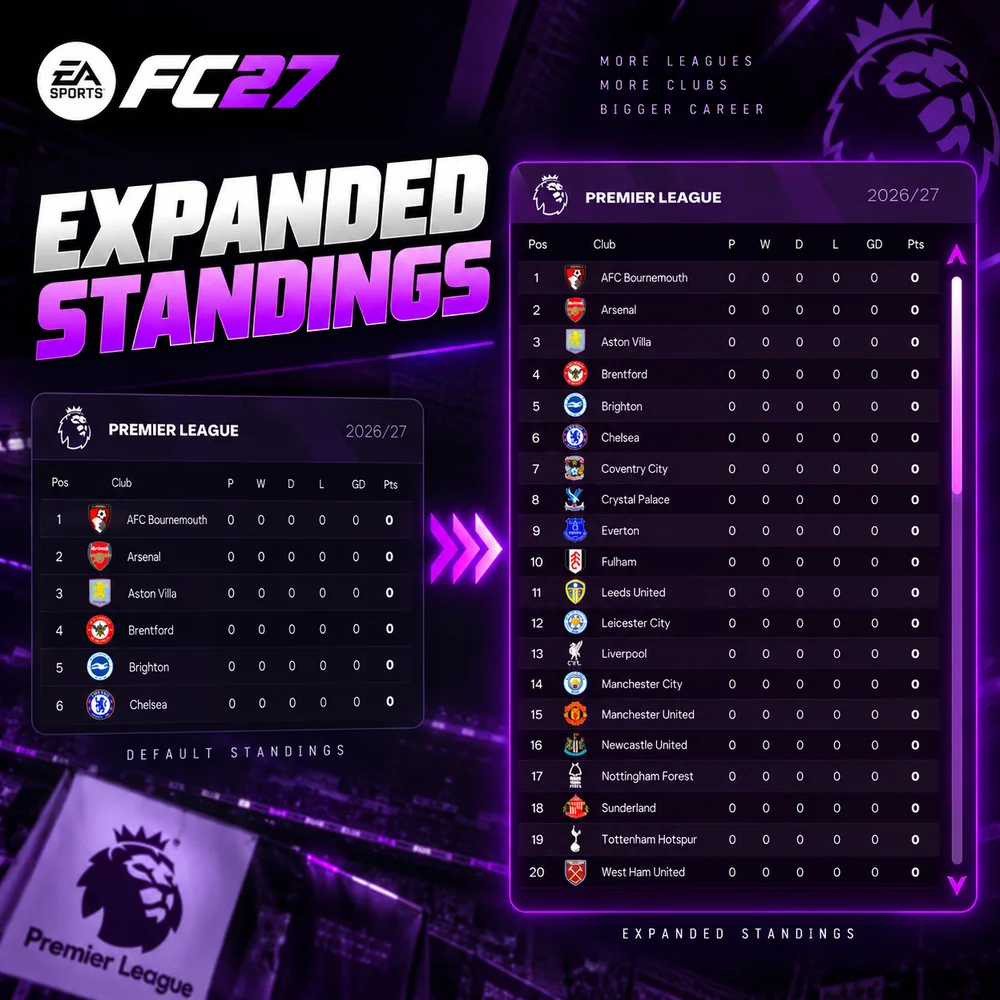
Tables & Brackets
Free: 10 to 14 teams in the table and up to 9 cup ties on one screen instead of 6 and 4.
Learn more
Ready for the new season?
One mod. The whole FIFAMAN ecosystem.
$10 a month on Patreon or Boosty. All 13 add-ons and every update included.
The same mod for $10 a month on both platforms — any card, any currency. Cancel anytime.
Don’t have the app yet? Download FIFAMAN App · How to install